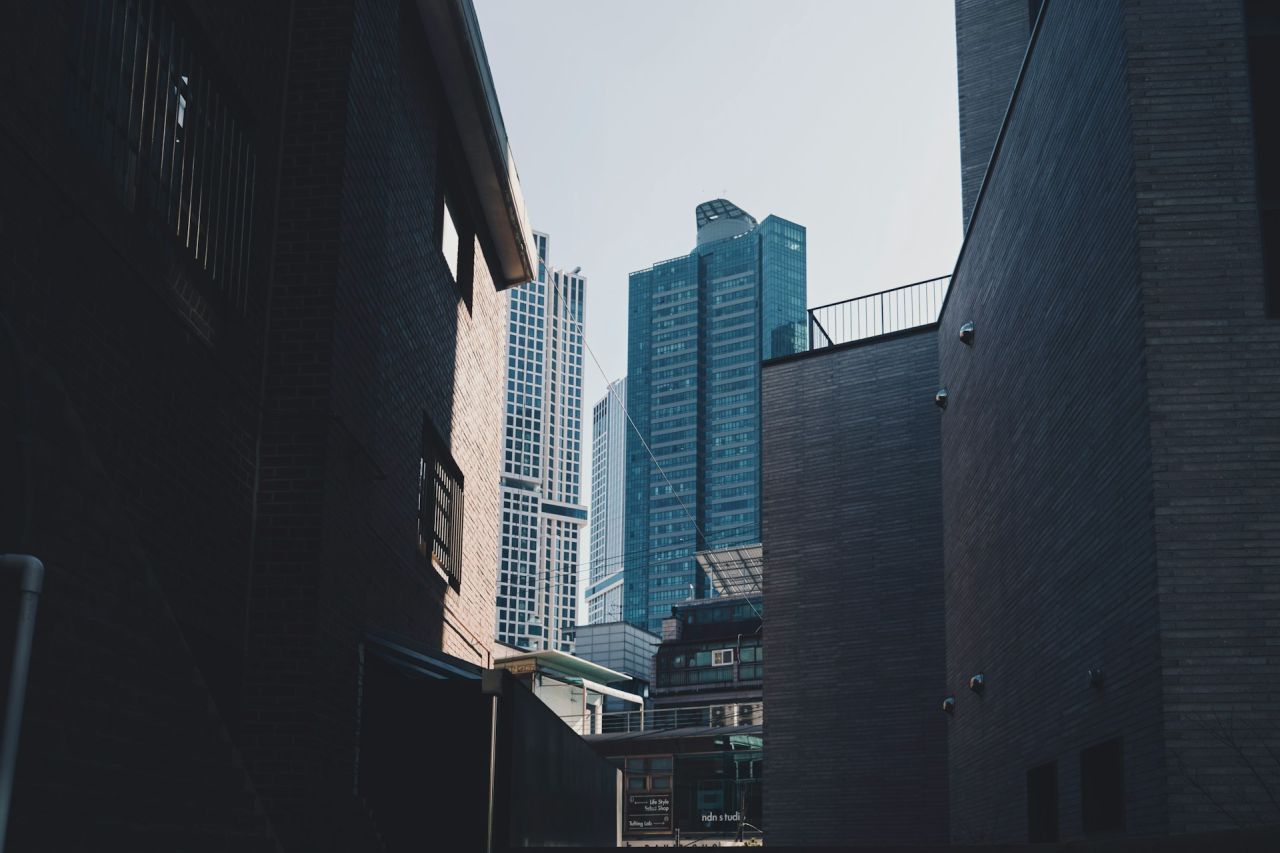
The tower of the de Young also has a great view of the western part of San Francisco. If it's a foggy day, you can admire the photo mural instead: Nope, this photo wasn't taken on a foggy day.
My favorite museum in Japan is the Hakone Open-Air Museum. It's a bit out of the way, which makes it an even more worthwhile trip. I've only been there once, and I would love to go again.
Museums with nicknames also use "the." For example, the Met is the biggest museum in New York City. Just about every time I go there, I start in the cluster of rooms that contains Masterpieces of Western Art and I get exhausted making my way through them.
A nickname that doesn't use "the" is MoMA. It stands for the Museum of Modern Art. New York has a MoMA. So does San Francisco. Do you know of any other MoMAs?
Parks don't use "the": Golden Gate Park is the biggest park in San Francisco.
There is a theory about the formation of the self that goes something like this: Just after you are born, you cannot tell the difference between yourself and a chair. Of course you don’t know what a chair is, but in fact, that isn’t important to you at all. You only know that you are, and you are the only thing that there is. The chair is you. The air is you. Your mother is you.In this state of being, you are everything and everything is you. And the only thing that concerns you is needs. You need food. You need to sleep. You need to do number one and number two.
But of course you are wrong. Your conception of everything is wrong. You begin to realize that the chair is not you. It is something else. And the fact that there are other things is the first thing that we ever learn. And it is very frightening.
It is as if you are suddenly broken into a million pieces. What was once whole and full and complete has become fragmented, forever separated. Who are you? That chair is not you. It is not a part of you. What are you?
Can you picture yourself? I mean your entire self? Of course you can. You’ve looked at yourself in a mirror. You know what you look like. You have seen the entire you. But what about when you were born? And after you realized that your idea of you had been totally wrong?
Who are you? What are you? You realize that the right arm is a part of you. The left arm? Yes, that too. And those legs. And that part near the bottom that gets wet a number of times a day. And the part where food goes into. All those parts are parts of you. But they are parts. And you can’t get a sense of the whole. What is the whole of you?
Sarasaちゃん asks: "Are you sure you're not me?"
At first, you felt only needs. But now, you feel something different. You feel want, which is different from need. Without satisfying needs, you will die. You are sure of that. You need to end the feeling of hunger. You need to relieve the pressure of number one and number two. Without satisfying wants, you won’t die but you’ll be miserable. You want to be whole again. You want to be able to feel that you are everything and everything is you again. You want to be full and complete again. But of course it is not possible. Once you realize that your idea of you is wrong, you cannot go back to that sense of being whole ever again. You are forever separated from that content feeling of completeness. You want but you can’t get what you want. As Morpheus said:
Um, welcome to spelling class.
Wants and Needs. Wholeness and Separation. Those concepts kept coming to mind while I watched Miyazaki Hayao ’s most recent film, “Ponyo.” The most powerful scene in the film is Ponyo’s storm. It’s a whopper of a storm. Maybe she didn’t mean to whip up such a frenzy. She may not even realize she had caused the mess. That storm came because she wanted something that we have all wanted since we realized that the chair was really a chair and not us. She wanted to end the Separation. Ah, but in her case, it’s separation with a small “s.”
“Ponyo” is a love story for the kindergarten set. Little boy meets little fish. Little fish and little boy bond. Father of fish comes to take little fish home. Little fish wants to be with little boy again. The want that the little fish feels is the most powerful force in the film, so great that it can change a fish into a girl and create a tuna-powered storm that dwarfs fishing boats and floods a town.
The storm is Miyazaki’s way of depicting want. And maybe it is the best depiction of want I have ever seen. Want is the storm that we make and we really don’t care about what the storm does or who the storm affects. We just want to be at the tip of that storm, pistoning our chubby infant legs so that we maintain our position at the front and get where we want to go. The younger you are, the more powerful that storm can get. And the easier it is to maintain that storm.
Ponyo’s storm is a mighty creation because she is, after all, a child. And anyone, from children to the elderly, can understand the power of that creation. Ponyo never once looks back while she is at the front. No, because her sense of want is supremely powerful, like the want you felt when you realized that you are not who you thought. But as I watched it, I was exhilarated and at the same time horrified. It’s one heck of a storm, and it can wreak havoc.
After the storm, the movie loses steam. It starts to deal with another character’s want and that doesn’t seem as compelling as Ponyo’s. The moments that will stay with you are Ponyo's -- when she wills herself arms and legs; when she makes Sosuke's toy into a sea-faring vessel; when she discovers ham, and later, ramen:
"あ〜〜〜〜〜〜〜!!" "おいしそう〜〜!!"
"Ponyo" isn't quite up to the standards of "Totoro," the last film Miyazaki made with the kiddie set in mind. It's hard to be perfect twice, I guess.
Bo: What did you do last weekend? Abe: I backed to my hometown.
Let's look at Abe's answer because it doesn't make sense. What is the verb in the sentence? "Back." When we use "back" as a verb, it means to support or endorse. For example:
Newspapers in the U.S. always choose to support a presidential candidate a few days before the election. Last year, The New York Times backed Barack Obama while The New York Post backed John McCain.
You can also use "back" at the racetrack for the horse you gambled on. I backed the wrong horse in the last race and lost $100.
So, what should Abe have said? Abe: I went back to my hometown. go back = return
Phrasal Verbs back up (driving) - During the driving test, you have to show the proper way to back up while parking.
A while back, my co-workers and I got into a conversation about what specific things turned each of us on. Yes, we were talking after work. I forgot most of the answers but there's one I still remember. One of the teachers said she really liked watching her boyfriend park his car. She said there is something very sexy about watching a guy look over his shoulder while turning the steering wheel, especially because he uses just one hand to steer. I wonder what the other hand is doing.
sexy? back up (computers) - You should always back up your files. If your computer crashes, you may lose all your work.
back off - After their first date, John called Kelly every day, sometimes twice a day. That's just too much. He needs to back off a bit.
We're in the middle of a run of unbearably humid and hot days in Osaka. Daily temperatures in Ibaraki are about 95ºF with the air nearly saturated with moisture. It's so bad, I'm writing sentences like a possessed weatherman.
We were thinking that we could be strong, that we could just grit our teeth and survive the next two months without an air conditioner. But we were wrong. We're weak. Yes, we're wusses. Yuki ordered a savior for us last night and it should get installed by Saturday. We need it. The computer needs it. It gets overheated way too quickly.
Guess who is having just an awful time?
Every day, she spends all her time in a never-ending quest to find a comfy spot -- some cool shady place to nap. When I open the front door to get some air circulating, she tries to take advantage:
Look, a chubby long-haired calico just wasn't built for a Kansai summer. Don't despair, Ponzie. Help is on the way!
Here's what the plum wine looks like after a month of rest in the closet:
You can see that all the rock sugar has dissolved. The plums have lost their vibrant green and look more pickled. They're starting to wrinkle a bit also. For a comparison, just scroll down or look here.
***
As long as I got the camera loaded, let's empty it out and see what's there. Hmmm...not much to choose from.
Here's a shot of the police box sign that I see a lot around here but never in Niigata:
I don't know why but the style of the drawing looks French to me. Can someone draw a Japanese-style toilet in the bottom left coner, please?
Next to my city is Takatsuki-shi (高槻市), home of factories and distribution centers. Meiji Seika, makers of the Meiji chocolate bar and カール, has a factory in Takatsuki with a huge mural on the side of one of its buildings:
Oh, and the last box from the US to be opened was the one containing Yuki's Gilbert & George print:
Here's the next winner of the 100m butterfly at the Special Olympics:
According to Yuki, the sea turtle had a traumatic encounter with a shark but thanks to some sympathetic engineers, Papa's got a brand new flap...er, flipper.
The turtle story was broadcast on NHK, the PBS of Japan. No, that's not quite right. People in Japan actually watch NHK. Plus, everyone here has been bothered by the NHK guy coming to your house to collect "donations."
I watch NHK for the dubbed nightly news but usually I don't pay attention to Japanese TV. Whatever Yuki is watching, I'll watch. Recently, that has amounted to just early morning talk shows. Yuki's got her nose stuck in her textbook so there isn't much time for TV. The one program we watched recently showed a lot of wacky/horrific news clips. If your perception of the world was informed only by this program, you'd think that:
• the preferred method of suicide in China/Thailand/South Korea is jumping off a tall building; • taxi drivers hate bicyclists; • only bizarre robberies occur at convenience stores.
One thing baseball fans like to do is imitate their favorite hitters, or favorite hitting stances. Do any come to mind just now?
I know which one I think of immediately -- the distinctive homeplate ritual used by Ichiro Suzuki, the singles-hitting machine. You've seen it before:
Like other famous people in Japan, Ichiro shills for a number of companies, including the alcohol of choice at frat houses everywhere. I see this one at train stations everywhere:
Yeah. Looks familiar, doesn't it. Maybe he's toasting the pitcher at a wedding ceremony.
Gift from the Ocean
-
*Buri (Japanese Amberjack) nigiri-zushi*
Buri is such a valued fish in this area.
There was a small catch just the other day. So I bought a small fillet ...
Old photos of Jeollanam-do and Gwangju.
-
[image: 1941 Jeollanamdo Provincial Office]
*Taken in front of the Jeollanam-do Provincial Office, 1941.*
[image: Sajik Park]
*Sajik Park observatory in the...
So Long, But Not Farewell
-
When I started this blog, five days short of a year ago, I always knew this
day would come. And now that it has, I find myself torn between excitement
and ...
In the loin
-
I am subbing for a language school, and my students were complaining about
their "hotel." It's in the very tender part of the tender-knob, and well,
they d...
Belated Obon Post
-
Obon was about a month ago now but it was one of the coolest things that
has happened in Japan so I think I will tell you about it now that I’m
finally get...